How Benchmarq works
Benchmarq helps you measure and improve how AI search engines, crawlers, and agents find, understand, and cite your website. This guide walks through the full workflow — from signing up to running scans, reading reports, and using advanced tracking features on paid plans.
Step-by-step guide
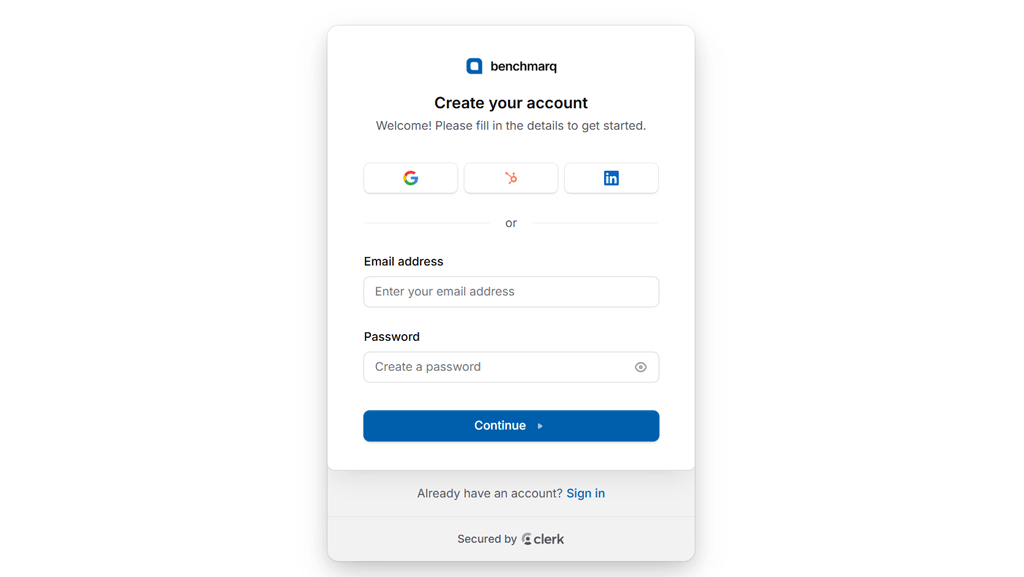
Create your account
Start by registering at app.benchmarq.io.
You can sign up with Google, HubSpot, LinkedIn, or a traditional username and password.
Once verified, you automatically land in your workspace and are ready to run your first audit.
Start a new scan
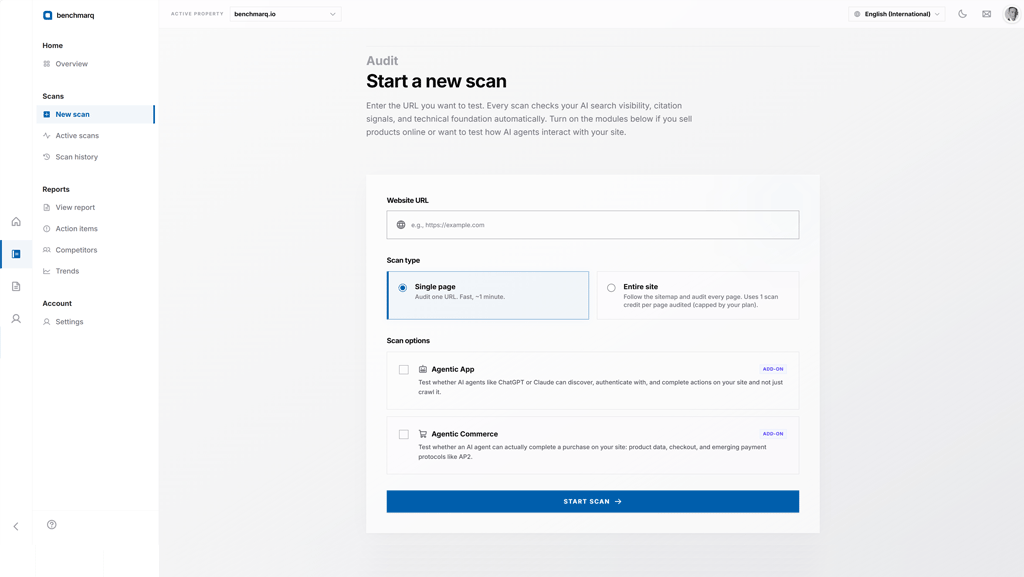
Open the new scan form and enter the domain you want to audit.
Choose your scan type: Single page audits just the URL you entered, using one scan credit. Entire site follows your sitemap and audits every page it finds, using one scan credit per page, so check your plan's page allowance before running it on a large site.
Every scan runs the core visibility checks (GEO, AIO, AEO, CORE) automatically. This is what determines your overall score.
If you want to go further, turn on Agentic App to test whether AI agents can log in and take action on your site, and Agentic Commerce to test whether an agent can complete a purchase, including product data, checkout, and payment protocols like AP2. Both add-ons can be enabled together, and they report separately without affecting your overall score.
Submit the form to queue your scan.
Monitor the active scan
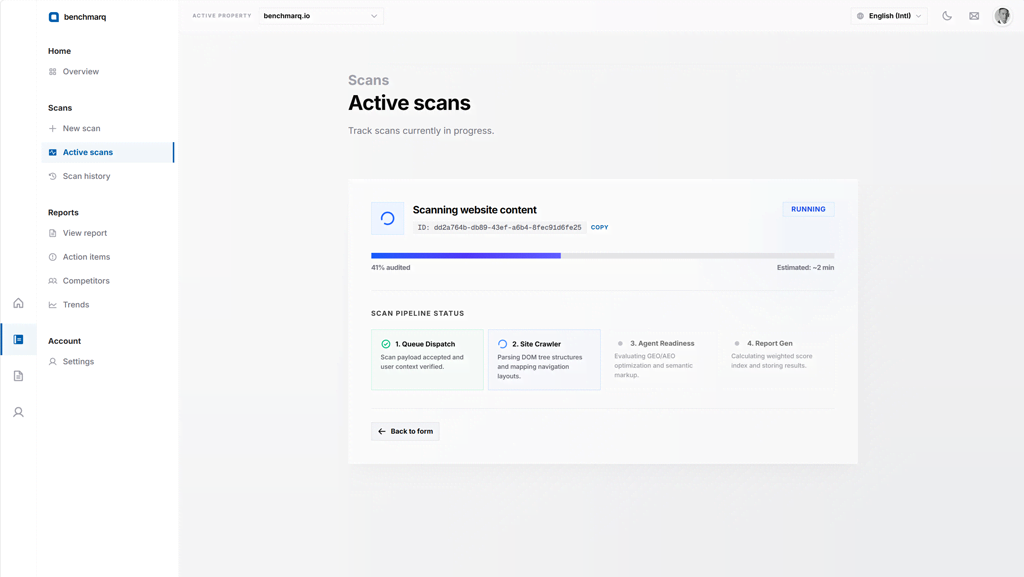
While your scan runs, the active scan page shows real-time pipeline progress — from queue dispatch through site crawling, agent readiness checks, and report generation.
In the background, Benchmarq executes over 200 tests across GEO, AIO, AEO, and CORE visibility pillars.
View your report
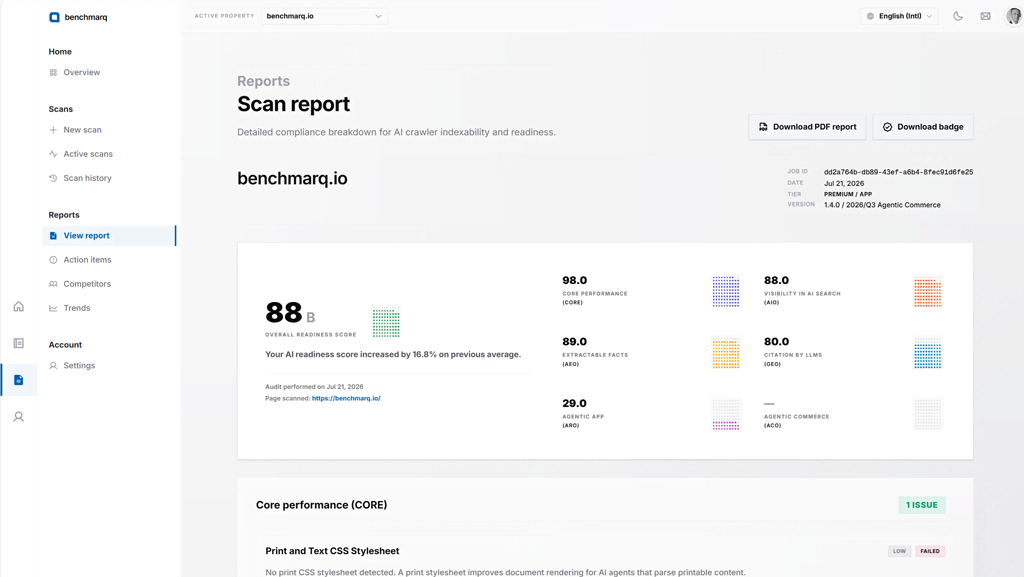
When the scan completes, open the report to see your overall visibility score and a breakdown by pillar.
Each pillar — GEO, AIO, AEO, and CORE — is scored independently so you can see exactly where your site is strong and where it needs work.
Drill into individual test results and download the full report.
Use the dashboard
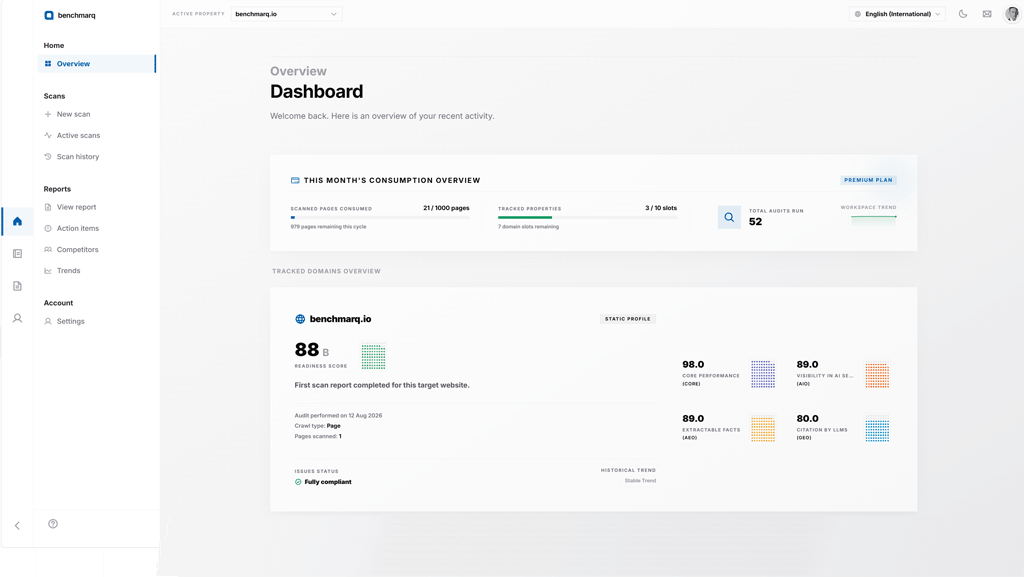
The dashboard is your home base.
The consumption overview panel shows how many scans you have used against your plan allowance.
The tracked domains panel lists every domain you are monitoring, with quick access to recent reports and the option to start a new scan.
Manage account settings
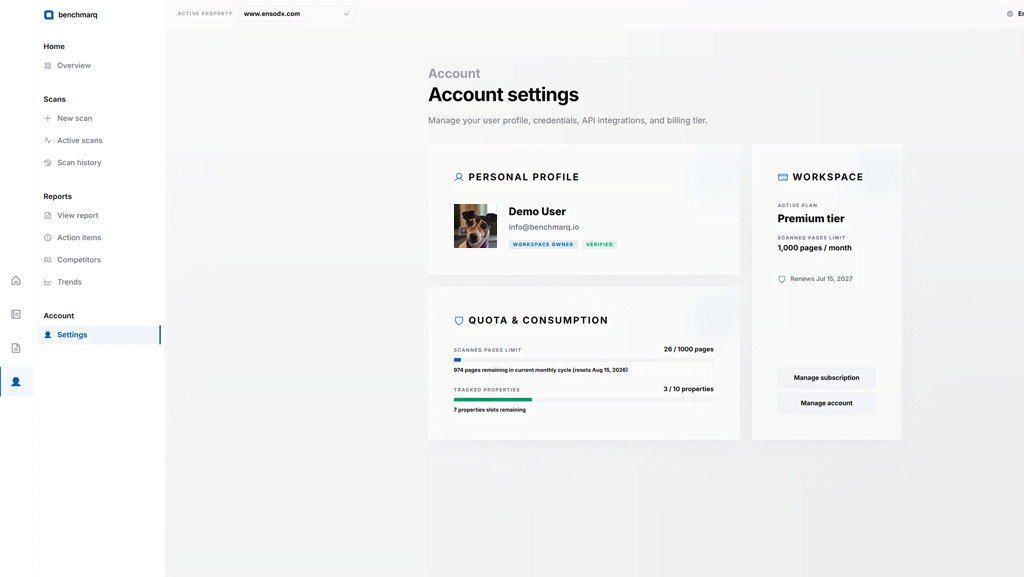
In account settings you can review your consumption panel to see detailed usage history.
The workspace section lets you manage team members, view your current plan, and upgrade to access more scans, tracked domains, and premium features through the plans and pricing page.
Paid tier features
The features below are available on paid tiers of Benchmarq. Upgrade your workspace from Account settings to unlock action items, competitor tracking, and trend analysis.
Work through action items
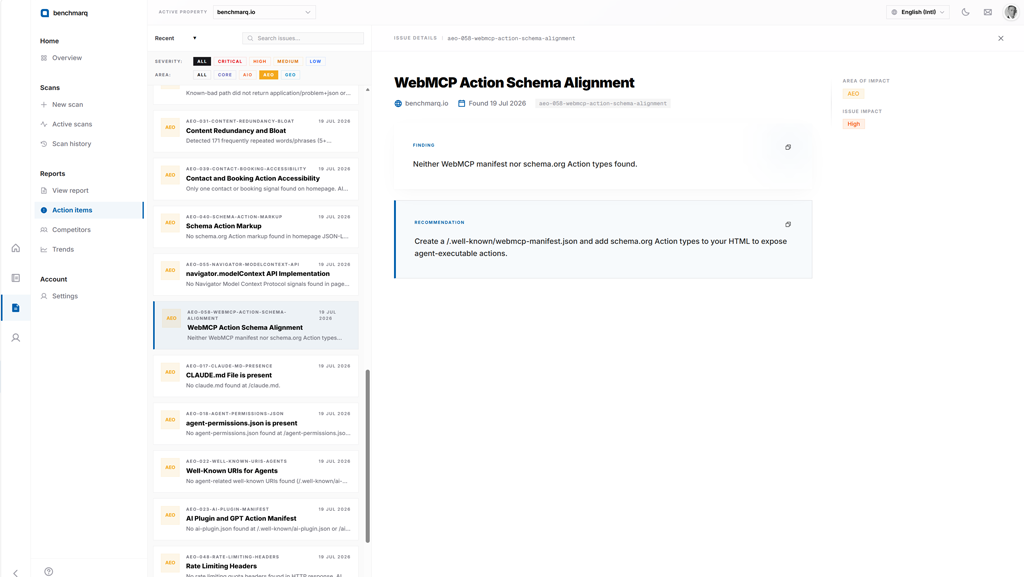
Action items turn audit findings into a prioritized to-do list.
Each item links back to the relevant test result and includes guidance on what to fix and why it matters for AI visibility.
Filter by pillar, severity, or status to focus your team's remediation efforts.
Track competitors
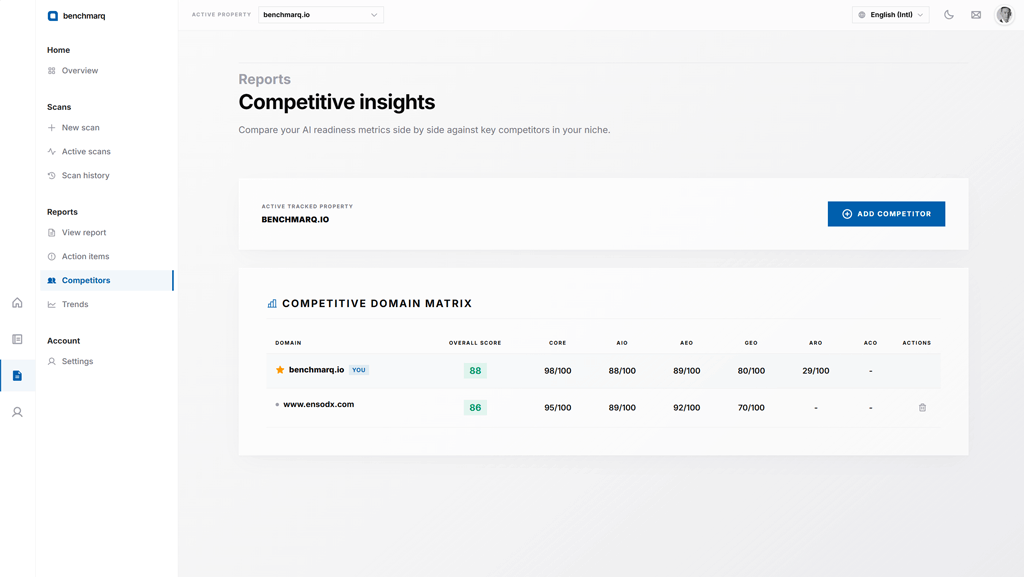
Add up to four competitor domains to benchmark your AI visibility against the market.
The competitors screen shows side-by-side score comparisons, pillar-level differences, and trend indicators so you can see where rivals are outperforming you.
Analyze trends
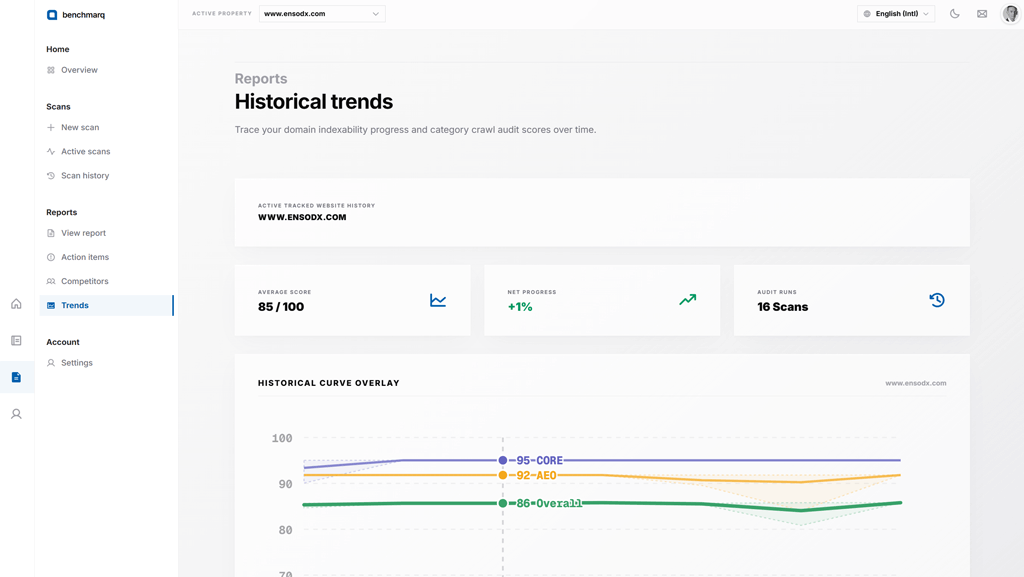
The trends screen tracks how your scores change over time across scans.
View overall and per-pillar trends, spot regressions after site changes, and measure the impact of your remediation work. Trends help you prove progress to stakeholders with data, not guesswork.
Ready to get started? Create your account or sign in.