Micro-segments & industry scores.Go beyond industry scores: benchmark against real peer micro-segments.
A boutique consultancy should not be scored against Big Four firms or global media giants. During every scan, Benchmarq automatically detects your NACE industry classification, technology stack, and regionality—ranking your website across every peer cohort it genuinely belongs to.
Synopsis
- Three classification axes
- Every scanned domain is automatically classified by standardized NACE industry code, detected CMS or tech stack, and regionality (country, subregion, EU, Europe, worldwide).
- Multi-cohort placement
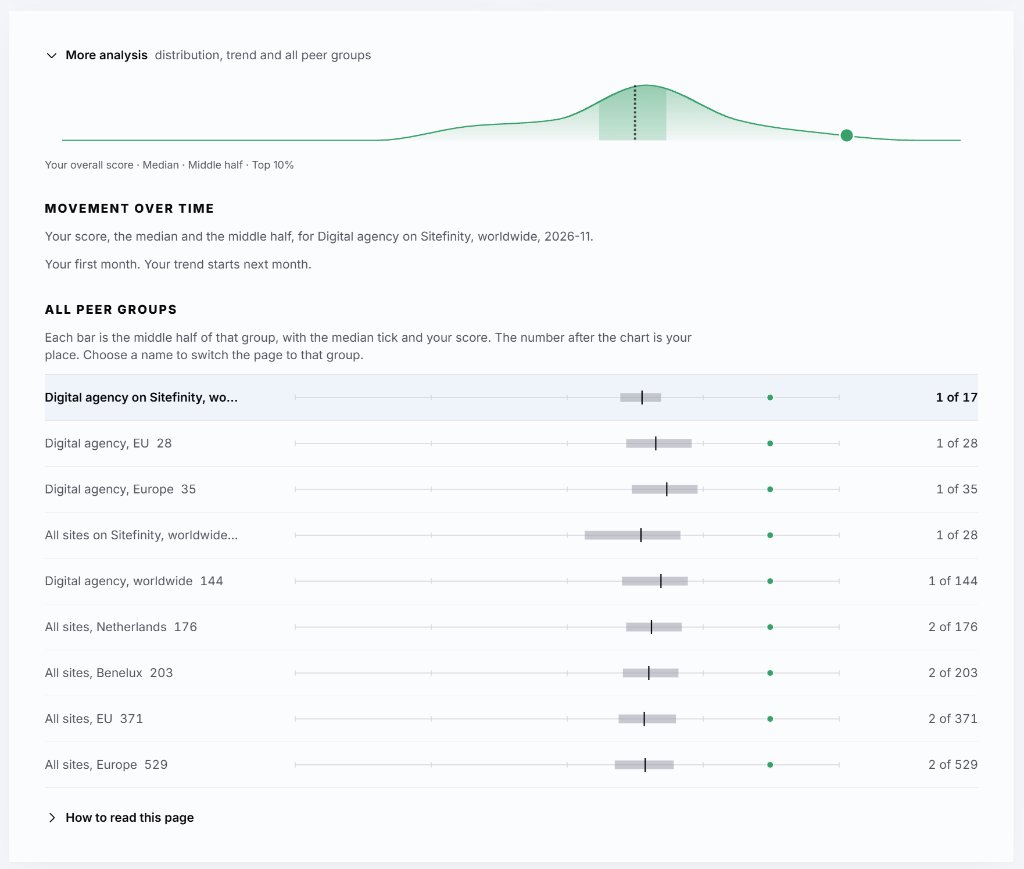
- A website can belong to multiple peer groups simultaneously, based on its industry, technology stack, and geographic market—switch between narrow stack-and-industry intersections and broader regional benchmarks in one dropdown.
- Open & closed segments
- Supports both open segments that grow continuously as more qualifying sites are indexed (such as digital agencies) and closed segments with a fixed, complete population (such as US state-capital websites).
- All six diagnostic pillars
- Compare overall rank, group median, interquartile middle half, top 10% threshold, and exact percentiles across CORE, AIO, AEO, GEO, ARO, and ACO.
- Peer-driven action items
- Surface the checks most peers pass that you fail—ranked by overall point gain and linked directly to Action items—plus the rare checks where you lead the group.
- Longitudinal movement
- Track monthly score movement against your cohort's median and middle half to verify that you are pulling ahead as standards evolve.
- Plan inclusion
- Included on Standard and Premium plans with zero manual setup. Start free to establish your baseline score. View pricing details.
Why broad industry benchmarks miss the mark
Global averages and broad industry scores are a starting point, but they flatten huge differences in company size, technology stack, and market region. Micro-segments compare like with like.
NACE industry classification
Grounded in standardized European NACE sector definitions rather than vague marketing tags, keeping your sector peers consistent and comparable.
Technology stack & CMS
Compare against other sites running the same platform or stack (for example, Sitefinity or modern SSR frameworks) so architectural constraints and strengths are apples-to-apples.
Regionality & market scope
Slice benchmarks by country, subregion (such as Benelux), EU, Europe, or worldwide to reflect regional compliance, language, and market norms.
Real example: ensodx.com (the team behind Benchmarq) is automatically placed into 9 cohorts—including Digital agency on Sitefinity worldwide, Digital agency EU, Digital agency Europe, All sites on Sitefinity worldwide, and All sites in the Netherlands, Benelux, EU, and Europe.
Not just where you rank—how you compare on every pillar
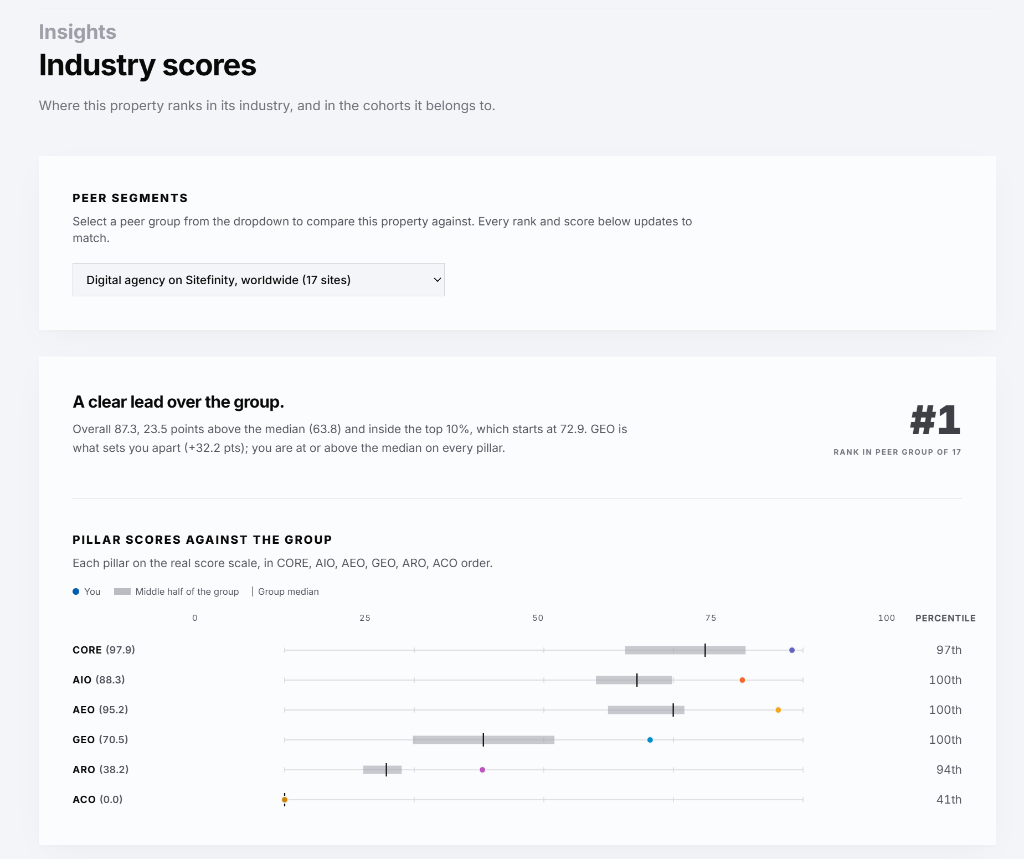
Select any peer segment from the dropdown and every rank, distribution bar, and percentile updates instantly.
Instant cohort position
See your exact rank in the peer group, how many points you sit above or below the group median, and whether you are inside the top 10%.
Pillar-by-pillar percentiles
Inspect CORE, AIO, AEO, GEO, ARO, and ACO plotted on the real 0–100 scale against the group's middle half and median so you spot immediately which pillar sets you apart or holds you back.
Turn peer gaps into prioritized engineering fixes
A rank alone does not tell your team what to ship next. Industry scores pair every cohort with concrete check-level actions.
What to fix next
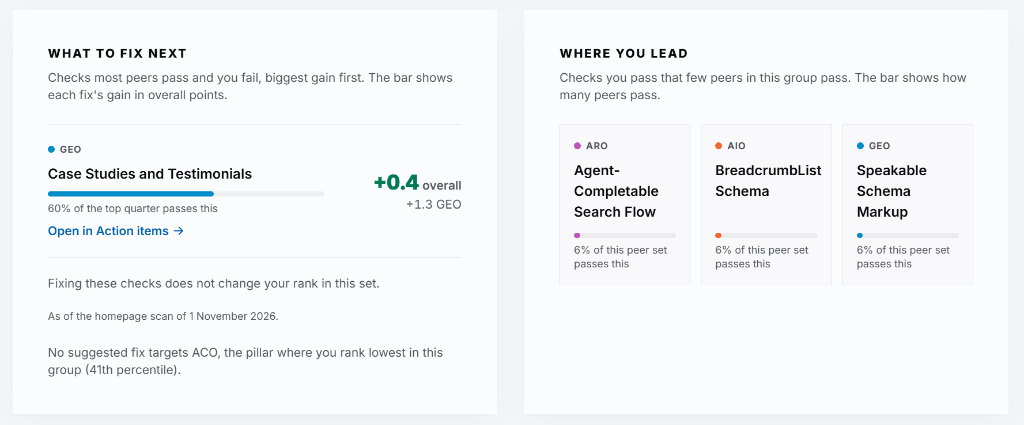
Lists the checks most top-quarter peers pass that you currently fail, ordered by projected overall and pillar point gain and linked straight into Action items.
Where you lead
Highlights the high-value checks you already pass that only a small fraction of your peer group passes—giving marketing and leadership concrete proof of technical differentiation.
Micro-segments vs. named competitor benchmarking
Traditional competitor comparisons ask: how do I compare with the companies I selected? Industry scores ask: how do I compare with websites that actually resemble mine—and what should I improve to close the gap?
Micro-segments & industry scores
Automatic, multi-cohort benchmarking across NACE industry, tech stack, and geography. Ideal for understanding true market norms, percentile standing, and stack-specific best practices without hand-picking domains.
Explore in Benchmarq UI →Competitor benchmarking
Side-by-side comparison against up to four specific competitor domains you choose. Ideal for closing the exact check-level gap against the rivals you pitch against directly.
Explore competitor benchmarking →Questions.
Direct answers about micro-segments and Industry scores.
How do Benchmarq micro-segments differ from broad industry scores?
Broad industry benchmarks lump every company in a sector together—scoring a boutique consultancy against global Big Four firms or comparing a headless Next.js storefront against legacy monoliths. Benchmarq goes beyond industry-only categorization by combining standardized NACE industry codes with detected technology stack and regionality, placing your domain into every specific peer cohort it genuinely belongs to.
Do I have to configure my industry, tech stack, or region manually?
No. During every scan, Benchmarq automatically detects your technology stack, NACE industry classification, and geographic footprint. Your domain is placed into every qualifying peer cohort automatically, with zero manual setup.
How many cohorts can a single domain belong to?
A single domain typically belongs to multiple overlapping cohorts at once—from narrow stack-and-industry intersections to broader regional groups. For example, ensodx.com (the team behind Benchmarq) is automatically placed into 9 cohorts, including Digital agency on Sitefinity worldwide, Digital agency Europe, All sites on Sitefinity worldwide, and All sites Netherlands, Benelux, EU, and Europe.
How is this different from Competitor Benchmarking?
Competitor Benchmarking compares your site 1-to-1 against up to four named rivals you choose yourself. Micro-segments and Industry scores benchmark your domain automatically against every relevant peer cohort across industry, stack, and region—so you see both where you stand against direct rivals and how you rank against websites genuinely like yours. Explore competitor benchmarking.
Which plans include micro-segments and Industry scores?
Micro-segments and Industry scores are included on the Standard and Premium plans, alongside Competitor Benchmarking and historical score tracking. Start on the Free plan to establish your baseline score. Compare plans.
See where you rank in your real peer cohorts
Run a free baseline scan in under 2 minutes, then unlock Industry scores and micro-segments on Standard or Premium to benchmark against websites genuinely like yours.